

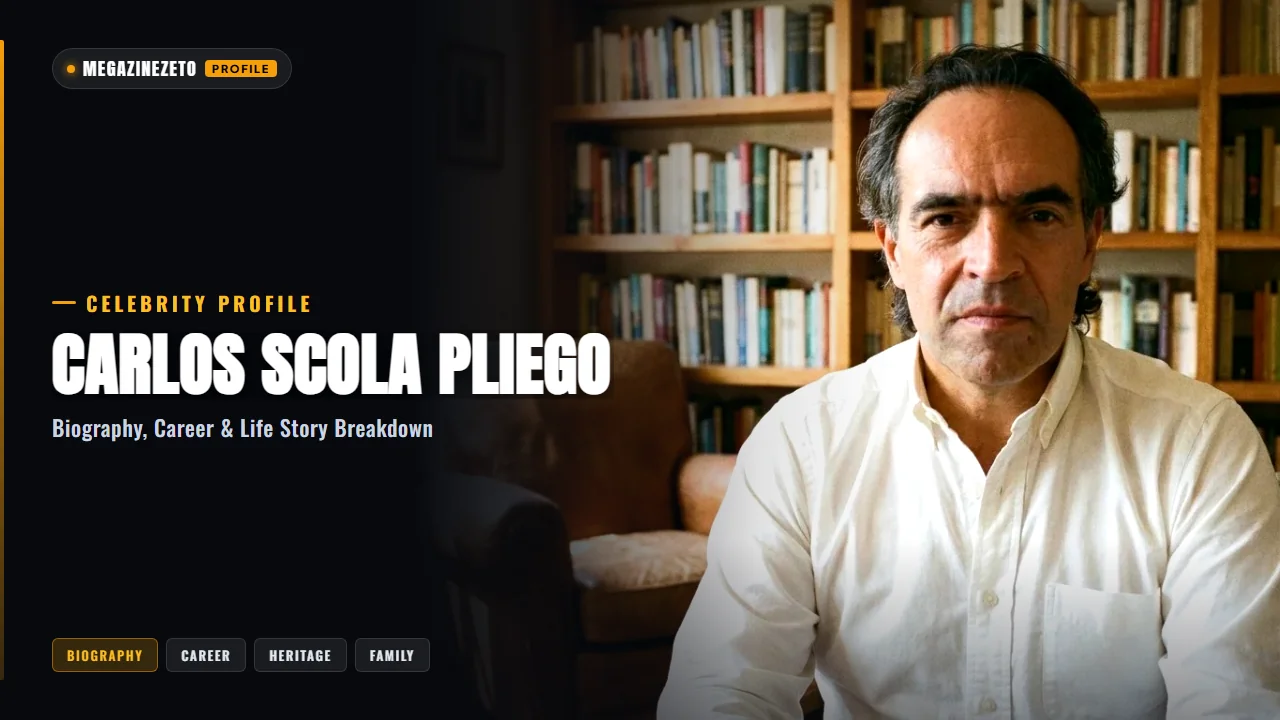
Carlos Scola Pliego Biography presents a Spanish filmmaker known publicly for marrying singer Sade. Public sources do not establish his birth date, current age, or a reliable net worth estimate. The couple married in 1989 and divorced in 1995, following about six years together. Available details about his personal life remain limited in widely accessible public records.
Scola Pliego and Sade married on March 11, 1989, in Spain, during her rise after Diamond Life. This article examines his film career, early background, relationship with Sade, marriage, and divorce. It also considers the limited public record concerning his life today. Together, these subjects provide a focused overview of the filmmaker beyond his public marriage.
Carlos Scola Pliego Biography: Quick Bio
Carlos Scola Pliego is a Spanish film professional linked to several 1980s productions. His public story mainly concerns his March 11, 1989, marriage to Sade and their 1995 divorce. Records connect him with Spanish cinema. Meanwhile, reliable sources provide little information about his birth, finances, later work, or present home.
| Attribute | Details |
|---|---|
| Full name | Carlos Scola Pliego |
| Profession | Film director and producer |
| Nationality | Spanish |
| Industry | Spanish film and television |
| Known relationship | Former husband of Sade |
| Marriage date | March 11, 1989 |
| Marriage country | Spain |
| Divorce year | 1995 |
| Marriage length | About six years |
| Sade’s profession | Singer and songwriter |
| First Sade album | Diamond Life, 1984 |
| Film credit | El jardín secreto, 1984 |
| Film credit | A la pálida luz de la luna, 1985 |
| Public children record | No children are documented from his marriage to Sade |
Who Is Carlos Scola Pliego?
Carlos Scola Pliego is a Spanish filmmaker whose public profile grew through his connection with Sade. He worked in cinema during the 1980s, when Sade released Diamond Life in 1984 and Promise in 1985. His name later appeared in entertainment coverage because of their six-year marriage.
Scola Pliego is not the same type of public figure as Sade, whose songs reached major international charts. His known story centers on film credits, a Spanish wedding in 1989, and a divorce reported in 1995. Unlike Sade, he has not maintained a large public music or media profile.
Available biographies give no confirmed birth date for Scola Pliego. That missing detail prevents a reliable age calculation in 2025. It also makes online claims about his age, personal fortune. Or present career difficult to verify against established film records and direct interviews.
Carlos Scola Pliego’s Early Life and Background
Reliable public biographies reveal little about Scola Pliego’s childhood, parents, education, or first years in Spain. Film records place his professional work in the 1980s. Those records offer more detail about screen projects than his life before entering the Spanish film business. Available sources do not provide a confirmed birth date, family history, or account of his early schooling.
His background is generally described as Spanish, and his professional identity is tied to directing and production. The available record does not confirm a school, university, or formal film program. It also does not provide a verified birth year, hometown, or early-career interview with exact dates.
This limited biography matters because online pages often add personal details without naming a source. A confirmed fact is his link to Spanish cinema before March 1989. Another is his marriage to Sade, born Helen Folasade Adu on January 16, 1959, in Ibadan, Nigeria. Public summaries should distinguish dated records from later claims about his private life.
How Carlos Scola Pliego Started His Film Career
Scola Pliego entered the public record through Spanish film work during the 1980s. Credit listings associate him with projects from 1984 and 1985. The records do not clearly document his first paid job, training period, or the exact production that launched his career. Those two years are the clearest specific dates available in these brief career records.
His early credits show work behind the camera rather than a career as an actor. Titles linked with his name include El jardín secreto from. 1984 and A la pálida luz de la luna from 1985. These projects place his professional activity before his wedding to Sade.
The available film record remains smaller than Sade’s music history. Sade’s first album arrived in 1984, while Scola Pliego’s documented work belongs mainly to Spanish screen production. Public sources do not provide a detailed account of his agents. Mentors, contracts, or move from one film role to another.
Movies and Documentaries Carlos Scola Pliego Worked On
Film databases connect Carlos Scola Pliego with Spanish productions from the 1980s. The titles most often associated with him include El jardín secreto, released in 1984. A la pálida luz de la luna, released in 1985. Some online listings also connect his name with other production work. See IMDb filmography and entertainment database for more.
His credits are sometimes presented differently across entertainment sites and film databases. One listing may describe him as a director, while another emphasizes production work. Readers should also separate confirmed title references from broad claims about a long filmography spanning the 1980s and 1990s. Dates and job titles can vary when databases rely on incomplete source material. A careful account should identify each credit and its supporting record.
The phrase “Carlos Scola Pliego films” usually appears in searches because readers want a career separate from Sade. His public screen record is much less detailed than her albums, including Diamond Life in 1984 and Strong in 2000. His best-known public connection remains personal, not cinematic.
No reliable source supports a large documentary catalogue under his name. Some pages repeat film titles without giving production roles, release dates, or database records. For that reason, the safest account includes the 1984 and 1985 titles while avoiding unsupported claims about awards. Box-office totals, or later releases.
How Carlos Scola Pliego Met Sade
Reports place Scola Pliego and Sade in Spain during the 1980s. During that period, he worked in film while she was building her music career. The exact meeting date is not firmly documented. Their relationship became public before their March 11, 1989, wedding. Public accounts so support a timeline, but not a detailed account of how they first met. See Forbes wealth tracking and valuation archives for more.
Sade had released Diamond Life in 1984, making her a rising international artist by the time she met Scola Pliego. The album included “Your Love Is King,” her first UK hit single. Scola Pliego, meanwhile, was associated with Spanish screen work from the same period.
Several biographical accounts describe their meeting through the film world, but they do not agree on the exact setting. Some mention professional circles in Spain, while others provide no meeting details. No dependable interview gives a full first-meeting story, private conversation, or confirmed courtship timeline.
The public record does establish that the relationship led to marriage in 1989. It does not establish that Scola Pliego inspired a particular Sade song. Sade’s songwriting credits involve several collaborators, and claims linking individual lyrics to him remain interpretation rather than documented fact. No cited source identifies a specific lyric or track as a direct reference to him.
Carlos Scola Pliego and Sade’s Marriage in Spain
Carlos Scola Pliego married Sade on March 11, 1989, in Spain. Reports describe the ceremony as taking place near Madrid, although detailed official wedding records are not widely available. Available public accounts do not establish the exact venue, guest list, or ceremony format. Their marriage lasted about six years before ending in divorce during 1995.
The wedding came after Sade’s first two albums, Diamond Life in 1984 and Promise in 1985. By 1989, she was an established international singer with a strong audience in Britain, Europe, and North America. Scola Pliego remained linked to Spanish film rather than pop performance.
Coverage of the marriage often focuses on Sade’s fame, leaving few verified details about their daily life. Public accounts do not document a shared home address, household finances, or a detailed travel history. No children are documented from their marriage, and later family claims should not be assumed.
The marriage also receives attention because Sade rarely discusses private relationships in detail. Her public career continued through albums such as Love Deluxe in 1992 and Lovers Rock in 2000. Scola Pliego’s public identity, but, remained connected mainly to Spain and film production. Coverage often identifies the couple by their wedding year and divorce year.
Why Carlos Scola Pliego and Sade Divorced
Scola Pliego and Sade divorced in 1995 after roughly six years of marriage. Reliable public sources do not give a confirmed legal reason for the split. Reports should so avoid presenting distance, career pressure, or personal conflict as established explanations. Available accounts do not identify court findings, statements, or documented events explaining the separation in public records.
The divorce followed Sade’s 1992 album Love Deluxe and came before her 2000 album Lovers Rock. Those release dates show the period of her continuing music career. But, they do not prove that any song described the marriage or its ending. The chronology alone establishes sequence, not causation. No reliable source links a specific track to the relationship.
Public reporting contains no verified statement from Scola Pliego explaining the divorce. Sade has also kept many relationship details away from interviews. The clear facts are the 1989 wedding, the about six-year marriage, and the 1995 divorce; the reason remains unconfirmed. Available biographies do not record a public explanation from either former spouse. Most accounts repeat the dates without adding a documented cause.
Did Carlos Scola Pliego Inspire Sade’s Music?
No reliable interview confirms that Carlos Scola Pliego inspired a specific Sade song. Their marriage began in 1989 and ended in 1995. But, Sade has not publicly named him as the subject of a lyric. Song interpretations so remain separate from documented biography.
Sade’s catalog includes Love Deluxe from 1992 and Lovers Rock from 2000. Those albums appeared before and after the divorce, yet neither release provides proof about Scola Pliego. Listeners may connect emotional themes with their marriage, but a personal reading is not a confirmed songwriting credit.
The public record supports a marriage, not a direct artistic explanation. Sade has often protected private relationship details, while Scola Pliego has given little public comment. Without a named interview, lyric note, or credit statement. Claims about his influence should be presented as speculation rather than fact.
Carlos Scola Pliego’s Life After the Divorce
Details about Scola Pliego after the 1995 divorce are scarce. Public databases continue to connect him with Spanish film work. But, they do not provide a dependable career timeline after the 1980s. No confirmed interview explains his professional plans, private address, or later relationships. Available references also provide little information about his life outside work.
Sade continued releasing music after the separation, including Lovers Rock in 2000 and Soldier of Love in 2010. Scola Pliego did not receive comparable international coverage. Those albums kept Sade’s name visible in music coverage long after their marriage ended. This difference helps explain why searches about his later life often return marriage details instead of current reporting.
There is no well-sourced record of another marriage, children, public awards, or major film release after the divorce. Those gaps do not prove that nothing happened privately. They show only that established entertainment sources have not documented those parts of his life with enough detail.
Where Is Carlos Scola Pliego Today?
Carlos Scola Pliego’s current location and work are not confirmed by reliable public reporting. Public information links him to Spain, 1980s film credits, and a 1995 divorce. No verified 2025 interview, business profile, or recent production record identifies his home, age, employer, or daily activities.
Carlos Scola Pliego Biography: The Bottom Line
The public record presents Carlos Scola Pliego as a Spanish film. Professional whose fame comes mainly from his former marriage to Sade. The known timeline includes 1980s screen work, a 1989 wedding, and a 1995 divorce. The remaining record is limited, so careful reporting matters more than unsupported claims about his private life or current plans.
When Did Carlos Scola Pliego Marry Sade?
Carlos Scola Pliego married Sade on March 11, 1989, in Spain. Their marriage lasted about six years and ended in divorce in 1995. Sade was already known for the 1984 album Diamond Life. Meanwhile, Scola Pliego was associated with Spanish film work during the 1980s.
What Movies Did Carlos Scola Pliego Work On?
Carlos Scola Pliego is associated with Spanish productions including El jardín secreto. From 1984 and A la pálida luz de la luna from 1985. Film listings describe his work in behind-the-camera roles. Though databases do not always agree about his exact position on every production.
Is Carlos Scola Pliego Still Alive?
No credible public report confirms Carlos Scola Pliego’s death. But, reliable sources also provide no recent interview or dated appearance that proves his current condition. The last widely reported milestones are his 1989 marriage to Sade and their 1995 divorce. So, his present status should be described cautiously.
Did Carlos Scola Pliego Inspire Sade’s Songs?
No documented interview proves that Carlos Scola Pliego inspired a particular Sade song. Their relationship covered the years 1989 to 1995, while Sade released albums such as Love Deluxe in 1992. Any connection between lyrics and the marriage remains a listener’s interpretation, not a confirmed fact.
Carlos Scola Pliego’s Children and Personal Life After Sade
No children are documented from Carlos Scola Pliego’s marriage to Sade. The couple wed in 1989 and divorced in 1995, but public accounts do not identify children from that relationship. They also do not provide a reliable family account covering his parents, siblings, or later household.
Sade later became a mother to Izaak Theo Adu, who was born in 1996. That birth came after her marriage to Scola Pliego ended. Izaak was born before Sade released Soldier of Love in 2010. Public biographies identify Izaak as Sade’s child, but they do not establish a parental connection between Izaak and Scola Pliego.
Information about Scola Pliego’s personal life after the divorce remains limited. No well-sourced record confirms another spouse, partner, or child. Public records also offer no dated account of his household or later family life. That caution matters because available reports provide no names, dates, or direct statements.
Carlos Scola Pliego’s Filmography by Year and Role
Available listings place El jardín secreto in 1984 and A la pálida luz de la luna in 1985. They connect Scola Pliego with Spanish production work, but role labels vary between sources. A complete, official filmography with every credit and job title is not readily available.
The 1984 and 1985 entries are useful because they place his screen career before his wedding to Sade. They do not prove that he directed every listed title. Readers should check the original credit records before calling him a director, producer, or writer on a specific project.
No verified award list, box-office figure, or later film title expands the record with confidence. The available evidence supports a short public film timeline rather than a large catalogue. That cautious description is stronger than assigning unconfirmed roles or adding productions copied across unsourced biography pages.
Net Worth
Carlos Scola Pliego has no reliable, sourced public net-worth estimate. Public records identify him as Sade’s husband from 1989 to 1995. A six-year marriage that shaped much of his public profile. His income, assets, film earnings, property holdings. Business interests have not been documented by Forbes, Celebrity Net Worth, or another recognized financial source.
Social Media Presence
Carlos Scola Pliego has no verified public social-media account documented on major platforms as of 2025. Public biographies identify him as a Spanish film director. Coverage mainly places him in Sade’s life through their 1989 marriage and 1995 divorce. Searches for Carlos Scola Pliego and Sade point to archival relationship coverage, not an active Instagram, Facebook, or X presence.
Frequently Asked Questions
What Is Known About Carlos Scola Pliego’s Life Beyond Filmmaking?
Carlos Scola Pliego keeps his private life largely out of public view. Available biographies focus mainly on his filmmaking career and marriage to Sade. Meanwhile, offering few verified details about later relationships, family circumstances, daily activities, or current projects. This limited record makes speculation about him unreliable.
What Was Carlos Scola Pliego’s Profession?
Carlos Scola Pliego worked as a Spanish filmmaker. Public biographies provide limited detail about his private life. However, sources associate him with film production and with singer Sade Adu during the 1980s. His professional record is less extensively documented than Sade’s, so specific credits and later activities should be treated cautiously.
What nationality was Carlos Scola Pliego?
Carlos Scola Pliego was a Spanish filmmaker and director whose career connected him to European cinema and documentary production. Public biographies focus heavily on his marriage to British singer Sade. Meanwhile, comparatively little verified information is available about his private life, upbringing, later work, or current activities.
What Is Carlos Scola Pliego Best Known For?
He is best known for his filmmaking career and marriage to singer Sade Adu. Publicly available biographies describe him as a Spanish film director and producer whose screen work and relationship attracted attention. Meanwhile, detailed records about his projects, later activities, and private life remain limited.
What roles did Carlos Scola Pliego hold in filmmaking?
Carlos Scola Pliego worked primarily behind the camera in Spanish cinema. He is described as a filmmaker and director, with credits also associated with production work. His career included contributions to films and documentaries. Though detailed public records of his individual responsibilities on every project are limited.
Who was Carlos Scola Pliego married to?
Carlos Scola Pliego was married to Sade, the British-Nigerian singer born Helen Folasade Adu. They married in Spain on March 11, 1989, and divorced in 1995. Their relationship is the main reason Scola Pliego appears in biographies and searches connected with Sade.
What does Carlos Scola Pliego do for a living?
Carlos Scola Pliego worked in Spanish film, with listings connecting him to productions from 1984 and 1985. His exact present occupation is not documented. Public sources do not confirm a current employer, later production, business, or other income source after his film activity.
Conclusion
Carlos Scola Pliego Biography describes a Spanish film professional remembered mainly through his marriage to Sade. His documented public timeline includes screen work in the 1980s, a wedding on March 11, 1989, and divorce in 1995. Beyond those points, reliable sources offer few personal details and no dependable financial estimate.
The available record does not establish where Scola Pliego lives or what work he does now. Carlos Scola Pliego Biography should so separate confirmed film listings from guesses about his private life. What comes next for him is not reported. Meanwhile, his connection to Sade remains the clearest part of his public story.

Connor Bailey is a celebrity content writer with a passion for uncovering the real stories behind the spotlight. With years of experience in entertainment journalism, Connor blends sharp research with engaging storytelling to bring readers accurate, up-to-date coverage of their favorite stars from red carpet moments to untold personal journeys.